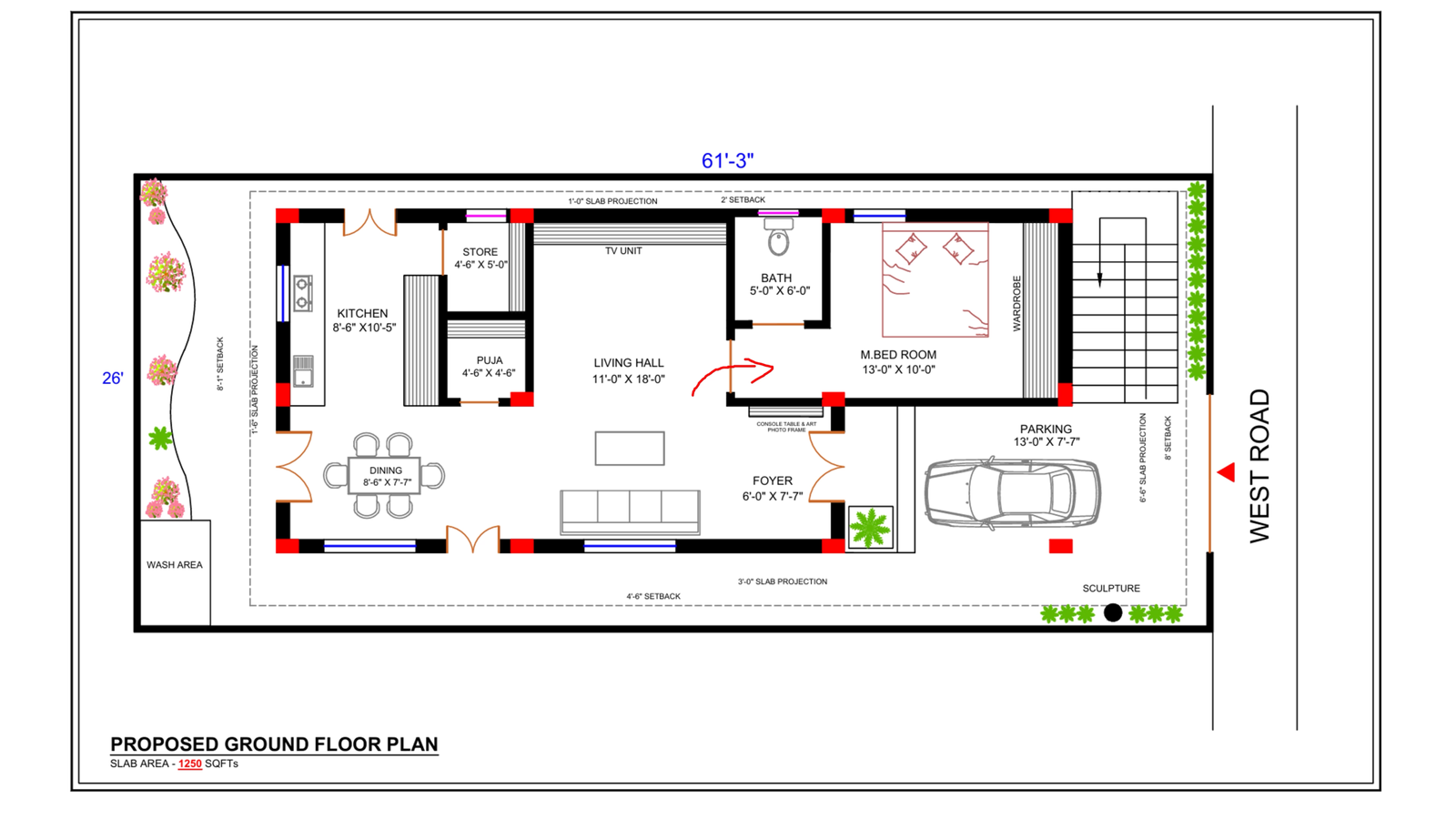
Planning a home on a west-facing plot often raises questions about Vastu, heat control, and internal comfort. With the right layout and zoning, a west-facing house can be just as functional, peaceful, and well-ventilated as any other orientation. This west-facing ground-floor house plan by Visual Nest is designed to address these concerns while delivering a modern, practical living experience for Indian families.
This article explains the planning logic, Vastu considerations, and functional advantages of this layout. You can also download this house plan for reference or construction use.
Plot Orientation & Planning Concept
- Facing: West
- Configuration: Ground Floor Residential Plan
- Built-Up Area: Approx. 1250 sq.ft
- Key Spaces: Living Hall, Dining, Kitchen, Store, Puja, Master Bedroom, Common Toilet, Parking, Staircase
West-facing plots receive strong evening sunlight, which can increase indoor heat if not planned properly. This layout smartly places service and circulation areas towards the west while keeping major living spaces comfortable and well-protected.
The plan follows a rectangular plot geometry, making it suitable for urban and semi-urban sites with setback regulations.
Entrance & Foyer – Privacy First
The main entry opens into a dedicated foyer, which is a crucial design decision. Instead of directly exposing the living hall, the foyer:
- Maintains privacy
- Improves visual control
- Creates a clear transition from outside to inside
From a Vastu perspective, controlled entry spaces help regulate energy flow, especially in west-facing homes.
Living Hall – Central & Spacious
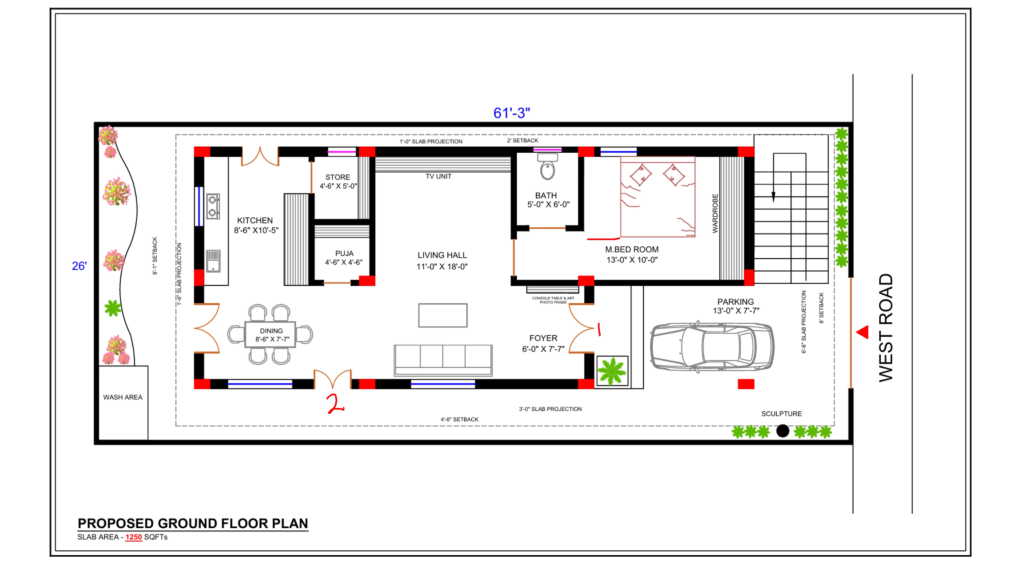
The living hall (11’-0” × 18’-0”) is the heart of the house and is centrally located for easy access to all areas.
Key Advantages:
- Clear furniture layout without obstructions
- Balanced proportions for seating and circulation
- Good ventilation through well-placed openings
The TV unit and wall seating arrangement are designed to minimize unnecessary movement and visual clutter, making the space suitable for both daily family use and guest visits.
Dining Area – Connected Yet Defined
The dining space (8’-6” × 7’-7”) is placed close to the kitchen and living hall, ensuring:
- Smooth serving flow
- Comfortable family interaction
- Efficient use of space
Even with a compact footprint, the dining area allows proper seating without crowding, which is essential for everyday Indian households.
Kitchen, Store & Wash Area – Functional Zoning
The kitchen (8’-6” × 10’-5”) is designed for efficiency rather than excess size.
Kitchen Planning Highlights:
- Continuous working counter
- Good ventilation
- Direct access to dining
A separate store room (4’-6” × 5’-0”) is a major functional advantage. It reduces clutter in the kitchen and supports long-term storage needs—something many modern homes lack.
The wash area, placed externally, keeps heavy utility work out of the main kitchen, improving hygiene and usability.
Puja Room – Calm & Purposeful
A dedicated puja room (4’-6” × 4’-6”) is thoughtfully integrated into the plan. It is neither hidden nor overly dominant.
From a Vastu and lifestyle point of view:
- It maintains spiritual focus
- Avoids conflict with toilets or bedrooms
- Fits naturally into daily routines
This balance is often missing in compact homes, making this placement a strong design choice.
Master Bedroom – Comfort with Privacy
The master bedroom (13’-0” × 10’-0”) is designed with both comfort and practicality in mind.
Features:
- Proper bed placement
- Dedicated wardrobe zone
- Easy access to the common bathroom
The room proportions allow free movement and furniture placement without compromising ventilation. This makes it suitable for long-term use rather than just visual appeal.
Common Bathroom – Smart Placement
The common toilet (5’-0” × 6’-0”) is placed for shared access while maintaining privacy from living and dining spaces.
Importantly:
- It does not occupy sensitive Vastu zones
- Plumbing lines are efficiently grouped
- Maintenance becomes easier over time
watch complete explanation on YouTube
Parking & Staircase – Future-Ready Design
The front parking (13’-0” × 7’-7”) comfortably accommodates a car without interfering with entry movement.
An external staircase is a smart addition:
- Supports future first-floor construction
- Keeps ground-floor privacy intact
- Allows independent access
This makes the plan ideal for families planning phased construction or rental floors in the future.
Why This West-Facing Plan Works
Many west-facing homes fail due to poor zoning and excessive exposure. This plan avoids common mistakes by:
- Protecting living spaces from harsh sunlight
- Maintaining privacy through foyer planning
- Separating utility, living, and private zones clearly
- Following practical Vastu principles without forcing symmetry
It is a realistic, buildable plan, not just a concept drawing.
Download This House Plan
Visual Nest provides an easy download option for this west-facing house plan, making it useful for:
- Homeowners
- Builders
- Civil engineers
- Interior designers
You can download the plan to:
- Study dimensions
- Share with your contractor
- Modify for your plot requirements
Final Thoughts
A good house plan works effectively in daily practice, not just on paper. This west-facing ground-floor house plan by Visual Nest proves that with thoughtful zoning, correct proportions, and practical Vastu alignment, west-facing homes can be comfortable, efficient, and future-ready.
If you are looking for a simple, functional, and Vastu-aware house design, this plan is a strong starting point.
For more such thoughtfully designed house plans, stay connected with Visual Nest.