Every city has its skyline story.
The early morning light hits glass towers, cranes move in rhythm, and cars below glide like ants around concrete giants. But every time you look up at one of those tall buildings — standing calm through wind, storms, and even earthquakes — have you ever wondered, what keeps it from falling?
It’s not just the concrete or the steel.
It’s something deeper, invisible, and incredibly powerful — Shear Wall Technology.
A few years ago, I visited a high-rise project in Hyderabad. It was a 20-storey commercial building under construction. As I climbed each floor, the wind grew stronger, and the structure gently swayed — a reminder that every tall building is constantly negotiating with nature.
The site engineer beside me smiled and said,
“Don’t worry, it’s supposed to move a little — but only this much, not more.”
He pointed to thick concrete walls cutting across the center and corners of the structure. “These are the shear walls,” he said. “They’re what keep this building upright when everything else wants to pull it down.”
That moment stayed with me.
We often talk about interior design, architecture, and materials — but we rarely talk about these hidden structural guardians that make skyscrapers possible. Let’s uncover what they are and why no modern building can stand safely without them.
What Exactly Is a Shear Wall?
A shear wall is not a normal wall that divides rooms.
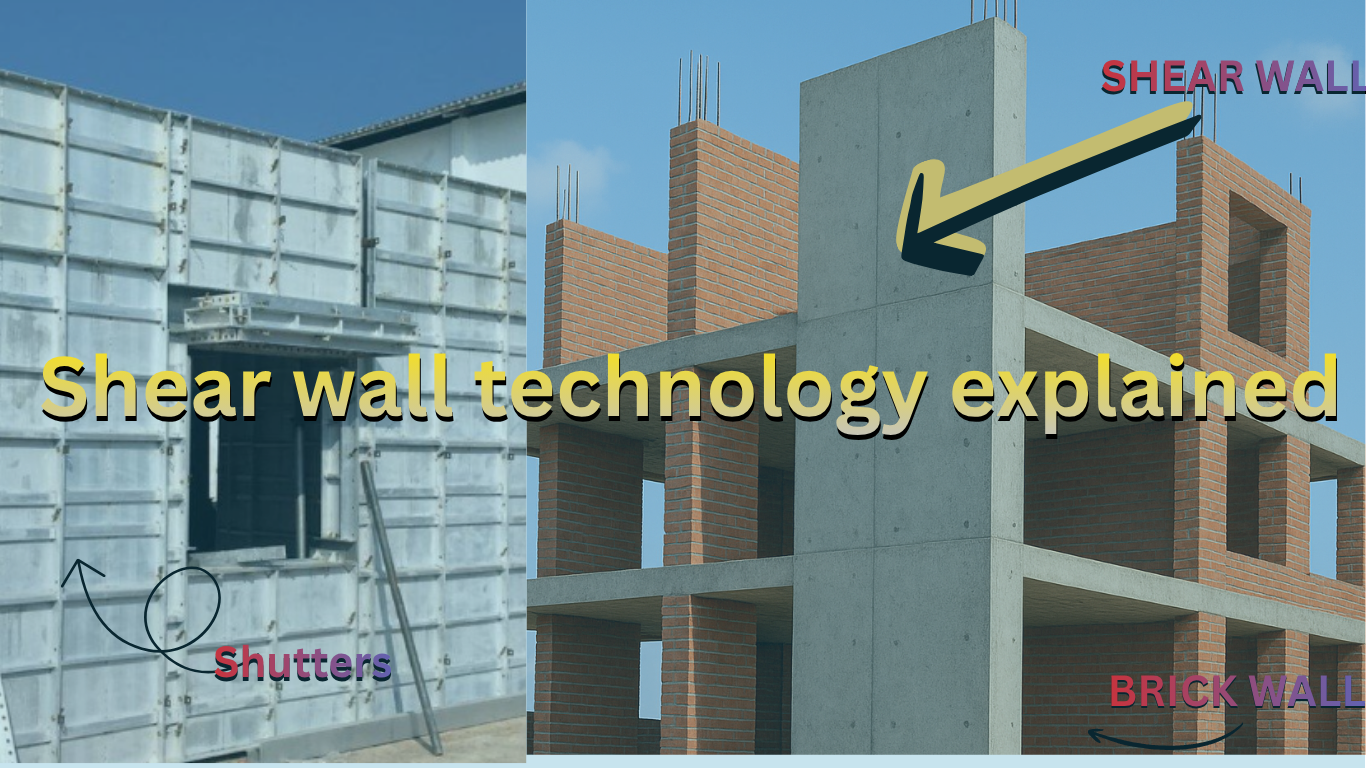
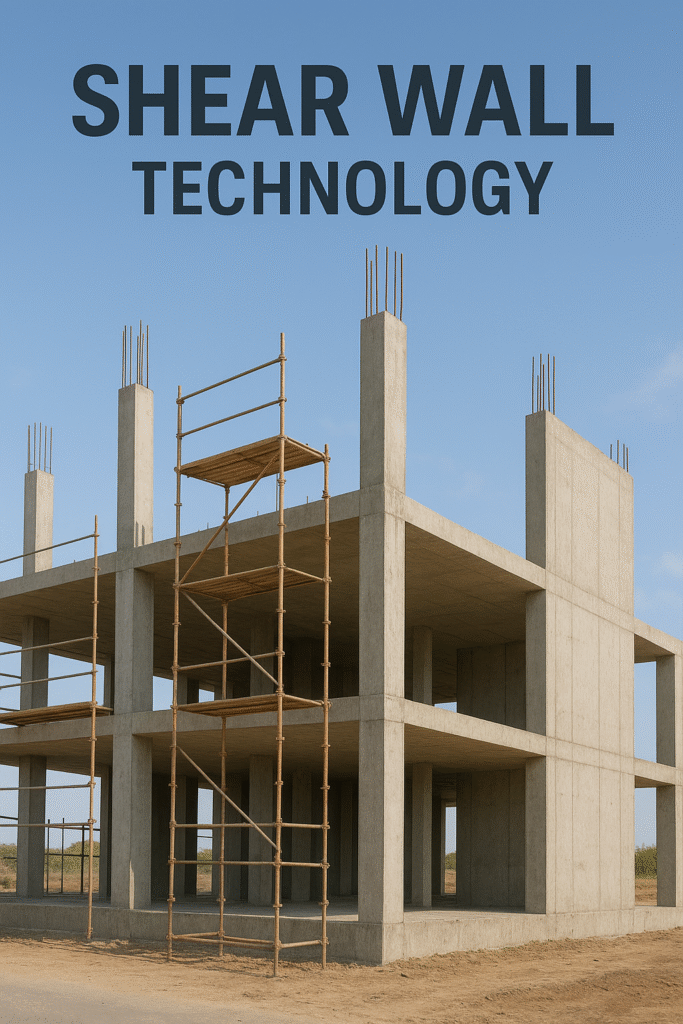
It’s a structural wall, made of reinforced concrete, designed specifically to resist lateral forces — the kind that push a building sideways during windstorms or earthquakes.
In simpler words, if columns and beams help a building stand vertically, the shear wall helps it stand firmly against sideways forces.
Imagine your building as a tall tree. The trunk gives strength, but the roots and surrounding soil prevent it from bending in storms. Shear walls play that “root” role — anchoring your structure against invisible pushes from nature.
Without them, high-rise buildings would wobble like a stick in the wind. With them, they gain a rock-solid spine.
Why Buildings Need Shear Walls
Every building carries two types of loads:
- Vertical loads — weight from floors, furniture, and people
- Lateral loads — pressure from wind, earthquakes, or uneven ground movement
Most people think about vertical loads because they’re visible — what’s being “carried.” But lateral loads are silent troublemakers. They twist, tilt, and shake buildings, especially tall ones.
Without proper resistance, these sideways forces cause:
- Cracks in beams and columns
- Discomfort (people can literally feel floors shaking)
- Structural failure during severe earthquakes
That’s where shear walls step in.
They absorb this lateral energy and redirect it safely down to the foundation. It’s like having shock absorbers inside your building.
More than Just Strength
Besides safety, shear walls bring several other advantages:
- Reduced sway: Buildings feel steadier during high winds.
- Faster construction: Concrete formwork systems make wall casting quicker than brickwork. (If you’re exploring innovative wall materials, you can also check our detailed article on Interlocking Bricks Technology — a smart alternative for eco-friendly and cost-effective construction.)
- Clean finishes: Smooth concrete surfaces reduce plastering and maintenance.
- Cost-effective: Fewer columns and beams are needed in the design.
So, when you live in an apartment that feels calm even during a storm, thank the invisible walls around your staircases and lift cores.
How Shear Walls Improve Stability
A shear wall works like a vertical cantilever beam — fixed at the base and extending upwards through the structure.
When lateral forces act on the building, these walls transfer the pressure evenly across their height and into the foundation.
The more walls there are, and the better they are positioned, the less the building bends or twists.
This is why engineers focus not only on adding shear walls but also on placing them symmetrically — ensuring the structure stays balanced from all sides.
If you place a shear wall only on one side, the building might resist the wind but twist around its center. But when shear walls are placed on both sides, or around the lift shaft, they act like the building’s core muscles — strong, stable, and coordinated.
Types of Shear Walls Used in Construction
Depending on the type and purpose of a structure, engineers choose different shear wall systems. Here are the most common ones:
- Reinforced Concrete Shear Walls
The most widely used type is thick concrete panels with steel bars running vertically and horizontally inside. Perfect for residential towers and commercial complexes. - Steel Plate Shear Walls
Made from thin steel plates and boundary frames — lighter but extremely strong. Common in skyscraper,s where reducing weight matters. - Plywood or Mid-Ply Shear Walls
Used in wooden and eco-friendly houses, especially in earthquake-prone countries like Japan. - Reinforced Hollow Block Shear Walls
A cost-effective alternative for medium-rise buildings. They balance strength and affordability. - Coupled Shear Walls
Two or more shear walls connected by horizontal beams (coupling beams). This increases flexibility and helps the structure dissipate seismic energy effectively.
Each wall type is selected based on the building’s height, soil condition, and design load — proving that even small details can transform a building’s safety.
Placement Matters: Where to Build Shear Walls
Having shear walls is one thing. Placing them right is another.
Engineers usually follow a few golden rules:
- Keep them symmetrical to avoid uneven twisting.
- Place them along the periphery (outer boundary) or around staircases and lift shafts — known as the building’s “core.”
- Ensure they run continuously from foundation to top floor for proper load transfer.
A balanced layout prevents concentration of stress in one part of the building and keeps the structure evenly strong.
When done right, the building not only withstands forces — it does so gracefully, without cracks or long-term strain.
Shear Wall vs. Conventional Framed Construction
In traditional RCC frame systems, columns and beams carry both vertical and lateral loads. As buildings rise taller, this system starts to struggle against strong wind and seismic forces.
Shear wall systems, on the other hand, separate these responsibilities. Columns handle vertical loads, and shear walls handle the horizontal ones.
That division of work makes the building:
- More stable
- Less prone to bending
- Easier to design safely for higher floors
This is why most high-rise apartments and commercial buildings you see today are shear wall–based, not because it’s a trend, but because it’s proven engineering logic.
The Real-World Impact
Cities like Hyderabad, Mumbai, and Bengaluru are filled with buildings that silently rely on shear wall systems.
From luxury apartments to corporate towers, these walls form the hidden skeleton that allows designers to push creativity further — larger balconies, open interiors, and slimmer facades — all made possible because stability is already taken care of.
For residents, it means:
- Less vibration or movement during storms
- Long-lasting walls without cracks
- Safer escape paths during emergencies
For builders, it means:
- Faster project timelines
- Less maintenance
- Higher resale value thanks to proven durability
So while the world sees glass, color, and lights, engineers see something else — the invisible network of strength holding it all together.
The Future of Shear Wall Technology
With modern prefabrication, advanced materials, and computer-aided design, shear wall systems are getting smarter and faster.
Engineers are experimenting with high-performance concrete, fiber-reinforced composites, and modular wall panels that can be installed in days instead of weeks.
The goal isn’t just strength anymore — it’s sustainability and efficiency.
A well-designed shear wall reduces construction waste, energy use, and the carbon footprint of a project.
As cities grow taller and denser, shear wall systems will continue to define the next era of safe, eco-conscious architecture.
Final Takeaway
The next time you step into a tall building, look around.
You may see glass panels, decorated lobbies, and shining elevators — but behind those finishes lies the true strength of the structure: the shear wall.
It doesn’t speak, it doesn’t show — yet it holds everything together.
It takes the shock of the wind, the shake of the earth, and the weight of the world — quietly doing its job so people inside never feel the chaos outside.
A building may be designed for beauty, but it stands strong only because of what’s built unseen.